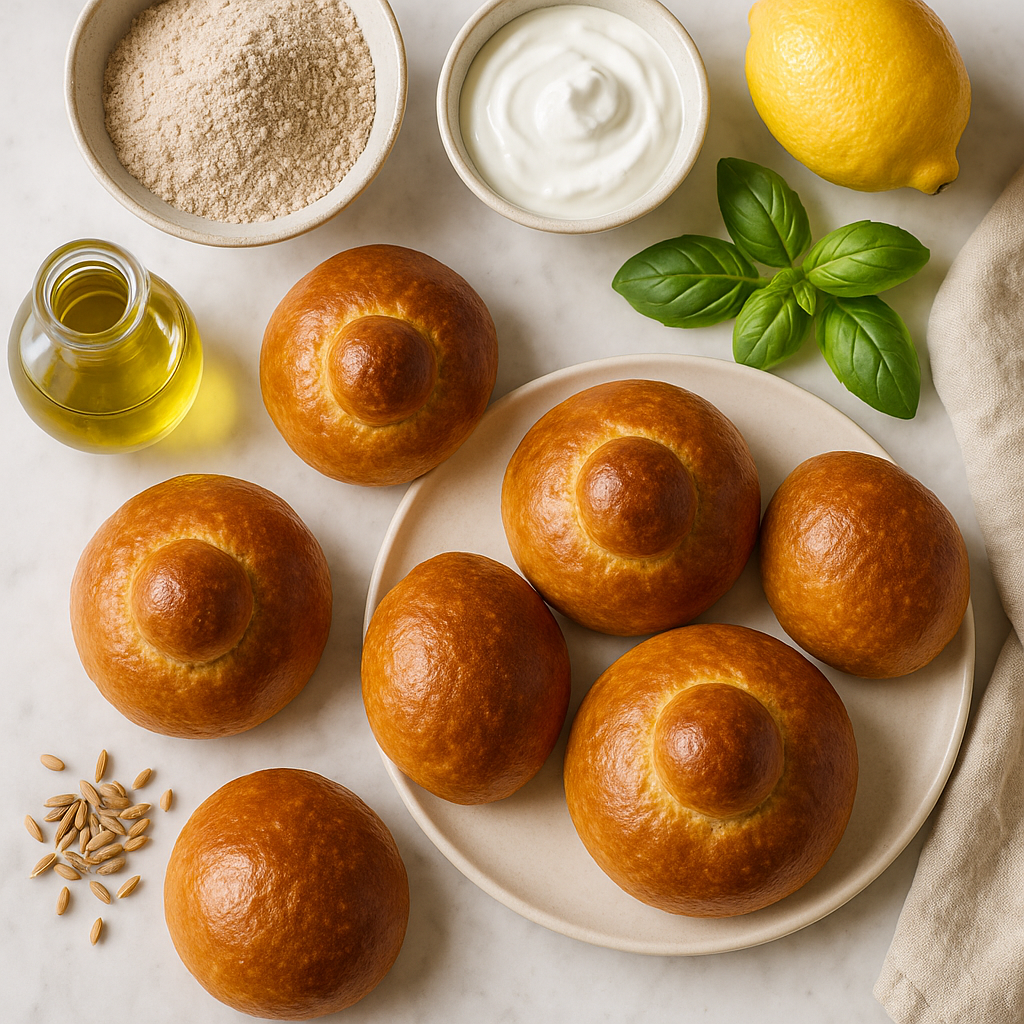
Sicilian Brioche Recipe Homemade with Whole Spelt and Greek Yogurt brings a genuine piece of Sicilian street food culture into your kitchen, made with ingredients that actually work for you nutritionally. The classic col tuppo bun, that round brioche with its little topknot, is traditionally eaten filled with granita or gelato for breakfast in Sicily. This version keeps that spirit completely intact while swapping refined white flour and butter for whole spelt flour and Greek yogurt. The result is a brioche that is lighter in texture than the traditional version, higher in protein, and rich in fibre without tasting remotely like a compromise. At 210 calories per bun with 8 grams of protein and 3 grams of fibre, these hold you through the morning far better than a conventional brioche would. If you have tried other healthier brioche recipes and found them dense or flavourless, this one is worth your time. The combination of two spelt flours gives it structure and a mild nuttiness, while the Greek yogurt keeps the crumb soft and adds a quiet richness that mimics the butter in the original.
Whole spelt flour carries the bulk of this recipe, at 300 grams, and it earns its place here for specific reasons. Spelt contains a broader amino acid profile than modern wheat, along with B vitamins including niacin and thiamine that support energy metabolism. It is also easier for many people to digest than conventional wheat because its gluten structure is more fragile and more soluble. The 100 grams of plain white spelt flour lightens the crumb just enough so the brioche does not feel heavy. Full-fat Greek yogurt at 120 grams brings genuine protein, probiotics, and a creaminess that replaces most of the butter you would normally use. Free-range eggs add structure, fat-soluble vitamins, and additional protein. Extra virgin olive oil at three tablespoons provides heart-healthy monounsaturated fats and keeps the crumb moist during baking. Coconut sugar adds a small amount of sweetness with a lower glycaemic index than refined white sugar. Raw honey feeds the yeast and adds trace enzymes. Orange zest is not decorative here. It contains limonene and contributes a bright, aromatic quality that lifts the whole flavour profile of the bun.
When you first mix this dough, it smells of orange zest and vanilla almost immediately, and that fragrance stays with it through the full proof and into the oven. The dough is softer and slightly stickier than a conventional bread dough because of the Greek yogurt, so do not be tempted to add extra flour at the mixing stage. After the first rise it becomes noticeably smoother and easier to handle. Shaping the col tuppo is satisfying once you get the ratio right. You take about four-fifths of each dough portion for the base and roll a small ball from the remaining fifth, pressing it gently on top. After the second proof, the buns look glossy and puffed, and the topknot sits proud of the base. In the oven they turn a deep amber gold. The crust is thin and tender, not at all brittle. Inside the crumb is open enough to feel light, with a slight chew from the whole spelt. The flavour is mildly sweet, faintly citrusy, with a warm background note from the vanilla that makes them smell like something far more indulgent than they actually are.
This recipe supports sustained morning energy because it balances protein, fibre, and complex carbohydrates in each bun rather than leaning entirely on fast-digesting refined flour and sugar. The 8 grams of protein per bun is meaningful at breakfast, especially when most sweet baked goods offer almost none. The fibre content of 3 grams helps slow glucose absorption, which means you avoid the spike and crash that usually follows a standard brioche. This recipe fits a vegetarian diet naturally. It works well for anyone managing their weight without wanting to cut out bread entirely, for people who are curious about whole grain baking, and for those who follow a Mediterranean-style approach to eating where olive oil, eggs, and yogurt are staple ingredients. Families with children will find these go down well because they taste genuinely good, not health-food-adjacent. Athletes and active people will appreciate having a portable, higher-protein baked good that is easy to prep in a batch and carry through a busy week without needing refrigeration for the first day or two.
These brioche are a strong meal prep project for the weekend. Once baked and fully cooled, they keep well at room temperature in an airtight container for up to two days. In the fridge they last four days, though a brief warm in the oven at 160 degrees for five minutes brings them back to something close to fresh. For longer storage, freeze them individually after baking and cooling, wrapped tightly. They defrost overnight at room temperature or in a low oven from frozen in about fifteen minutes. For variations, you can fold a teaspoon of ground cinnamon into the dough alongside the vanilla for a warmer spiced version. Lemon zest works beautifully in place of orange if you want something brighter and sharper. For a more savoury direction, reduce the coconut sugar by half, leave out the vanilla, and add a tablespoon of fennel seeds to the dough, which is a less traditional but genuinely good variation for serving alongside soft cheeses. All the quantities and full step-by-step method are in the recipe card below.
Ingredients
- 120 ml warm oat milk (around 38C, not hot or it will kill the yeast)
- 7 g instant dried yeast (one standard sachet)
- 1 tsp raw honey (to activate the yeast)
- 300 g whole spelt flour (plus extra for dusting)
- 100 g plain white spelt flour (or strong white bread flour for extra lift)
- 25 g coconut sugar (lower glycaemic index than white sugar)
- 1 tsp fine sea salt
- 2 large free-range eggs (at room temperature)
- 120 g full-fat Greek yogurt (plain, unsweetened)
- 3 tbsp extra virgin olive oil (mild variety preferred)
- 1 tsp pure vanilla extract
- 1 large orange, zest only (unwaxed if possible)
- 1 tbsp oat milk (for egg wash, mixed with a little beaten egg)
- 1 small egg yolk (mixed with the oat milk for egg wash)
Instructions
- 1
Combine the warm oat milk, instant yeast and raw honey in a small bowl or jug. Stir briefly and leave for 8 to 10 minutes until the surface looks frothy and active. This tells you the yeast is alive and ready to go.
If the mixture does not foam after 10 minutes, your yeast may be old or the milk too hot. Start again with fresh yeast.
- 2
In the bowl of a stand mixer fitted with a dough hook, combine the whole spelt flour, plain spelt flour, coconut sugar and sea salt. Whisk together briefly with a fork to distribute everything evenly.
- 3
Add the two eggs, Greek yogurt, olive oil, vanilla extract and orange zest to the dry ingredients. Pour in the activated yeast mixture. Mix on low speed for 2 minutes until a shaggy dough forms, then increase to medium speed and knead for 8 to 10 minutes until the dough is smooth, elastic and pulls away cleanly from the sides of the bowl.
The dough will be softer and slightly stickier than a standard bread dough. Resist adding too much extra flour, as this is what keeps the buns tender.
- 4
Shape the dough into a ball and place it in a lightly oiled bowl. Cover with a clean damp tea towel or cling film and leave to rise in a warm spot for 1.5 to 2 hours until doubled in size.
A switched-off oven with just the light on makes a perfect proving environment in cooler kitchens.
- 5
Once risen, turn the dough out onto a very lightly floured surface and gently press it down to release the gas. Weigh the dough and divide it into 8 equal portions. Set aside a small piece from each portion, roughly 17 percent of its weight, to form the tuppo. Roll each larger piece into a smooth ball and place on two baking trays lined with parchment paper.
Using a digital kitchen scale for portioning gives you evenly sized buns that bake at the same rate.
- 6
Roll each small piece of dough into a tight little ball. Use your finger to press a small indentation into the centre of each large dough ball, then press the small ball firmly into this indentation. It should sit snugly without falling off. This is the tuppo, the little topknot that makes Sicilian brioche instantly recognisable.
Press the tuppo down firmly so it bonds to the base during the second prove and bake.
- 7
Cover the shaped buns loosely with oiled cling film and leave to prove for a second time at room temperature for 45 to 60 minutes until noticeably puffed and pillowy.
- 8
Preheat your oven to 180C fan or 200C conventional. Mix the egg yolk with the tablespoon of oat milk and brush gently over each bun, taking care not to deflate the tuppo. Bake for 18 to 20 minutes until deep golden brown on top.
Rotate the trays halfway through baking if your oven has hot spots.
- 9
Remove from the oven and leave to cool on a wire rack for at least 10 minutes before serving. They are extraordinary eaten warm, but fully cooled buns hold their structure better if you plan to slice and fill them.
Nutrition per serving
210kcal
Calories
8g
Protein
30g
Carbs
7g
Fat
3g
Fibre
5g
Sugar
190mg
Sodium
Pro Tips
- ✓
Whole spelt dough is more delicate than white flour dough. Handle it gently when shaping to preserve the air bubbles built up during proving.
- ✓
For the most authentic Sicilian serving experience, scoop out some of the interior of a cooled bun and fill it with your favourite granita and a spoonful of whipped ricotta.
- ✓
Room temperature eggs and yogurt help the dough come together more smoothly. Take them out of the fridge 30 minutes before you start.
- ✓
Do not skip the orange zest. It is the single ingredient that most clearly defines the Sicilian character of these buns.
- ✓
If your kitchen is very warm in summer, reduce the yeast quantity slightly to 5g to slow the rise and develop better flavour.
Frequently Asked Questions
Variations
- •
Almond and Honey Sicilian Brioche
Add 30g of finely ground blanched almonds to the flour mixture and replace the coconut sugar with 2 tablespoons of raw honey for a naturally sweetened, slightly denser bun with beautiful almond fragrance.
- •
Lemon and Ricotta Filled Brioche
After baking and cooling, hollow out each bun slightly and fill with a mixture of whipped low-fat ricotta, lemon zest and a small drizzle of honey for a protein-packed breakfast treat.
- •
Sesame Topped Sicilian Brioche
Scatter white sesame seeds generously over the egg-washed buns just before baking. Sesame seeds add a subtle nuttiness and a boost of calcium and healthy fats.
Substitutions
- •Whole spelt flour → Whole wheat bread flour (Whole wheat flour works well but produces a slightly denser crumb. You may need a touch more liquid.)
- •Oat milk → Almond milk or regular semi-skimmed milk (Any warm milk will activate the yeast. Dairy milk will add a little more richness.)
- •Greek yogurt → Plain coconut yogurt (For a fully dairy-free version, use thick unsweetened coconut yogurt. The texture will be slightly different but still tender.)
- •Coconut sugar → Light brown sugar or date sugar (Any unrefined sugar works here. Avoid artificial sweeteners as they may affect yeast activity.)
- •Eggs → Flax eggs (For an egg-free version, use 2 flax eggs (2 tbsp ground flaxseed mixed with 6 tbsp water, rested for 5 minutes). The buns will be slightly less golden and rich.)
🧊 Storage
Store cooled buns in an airtight container at room temperature for up to 2 days. For longer storage, freeze individually wrapped buns for up to 2 months. Refresh from frozen in a 160C oven for 5 to 6 minutes.
📅 Make Ahead
You can prepare the dough through the first rise, then punch it down, cover tightly and refrigerate overnight. The next morning, remove from the fridge, allow to come to room temperature for 30 minutes, then shape, prove and bake as directed. This slower cold fermentation actually deepens the flavour.
You might also like
Italian Ricotta Frittata Recipe: High Protein Spinach and Sun-Dried Tomato
Italian Baked Frittata with Peas and Vegetables (High Protein, Low Calorie)