Portuguese Egg Tarts Low Sugar Homemade Recipe with Almond Flour Crusts brings a beloved Portuguese pastelaria classic into your own kitchen, reimagined with a nutritional backbone that the original version simply cannot offer. Traditional pastel de nata relies on white flour pastry and generous amounts of sugar, which means the custard hit comes at a real cost to blood sugar and overall nutrition. This version flips that entirely. At 145 calories per tart, with 8g of protein and only 4g of sugar, you are getting a genuinely satisfying treat that does not derail your morning goals. The almond flour crust changes the entire character of the tart, giving you a nutty, golden shell that also contributes healthy fats and fibre. For anyone who has wanted to enjoy egg tarts regularly without the blood sugar spike that follows a traditional version, this recipe answers that question properly. It is also meal prep friendly, so you can bake a full batch on Sunday and have breakfast or a post-workout snack ready for the whole week.
The ingredient list here is doing serious work, and it is worth understanding why each component earns its place. Almond flour, at 180g, is the backbone of the crust. It delivers around 6g of protein per 100g, along with magnesium, vitamin E, and a lower glycaemic load than refined wheat flour, which matters enormously when you are controlling sugar intake. The 40g of rolled oats adds beta-glucan fibre, which supports cholesterol management and keeps you fuller for longer. Coconut oil binds the crust together while contributing medium-chain triglycerides, a fat source the body converts to energy relatively quickly. The custard relies on four whole eggs plus two extra yolks, giving you a protein-dense filling rich in choline, which supports brain function. Full-fat coconut milk provides creaminess and healthy saturated fats that slow glucose absorption. Unsweetened almond milk thins the custard without adding sugar. Erythritol replaces cane sugar entirely, providing sweetness with virtually zero impact on blood glucose. Greek yogurt adds a gentle tang and extra protein, while pure vanilla extract grounds the flavour.
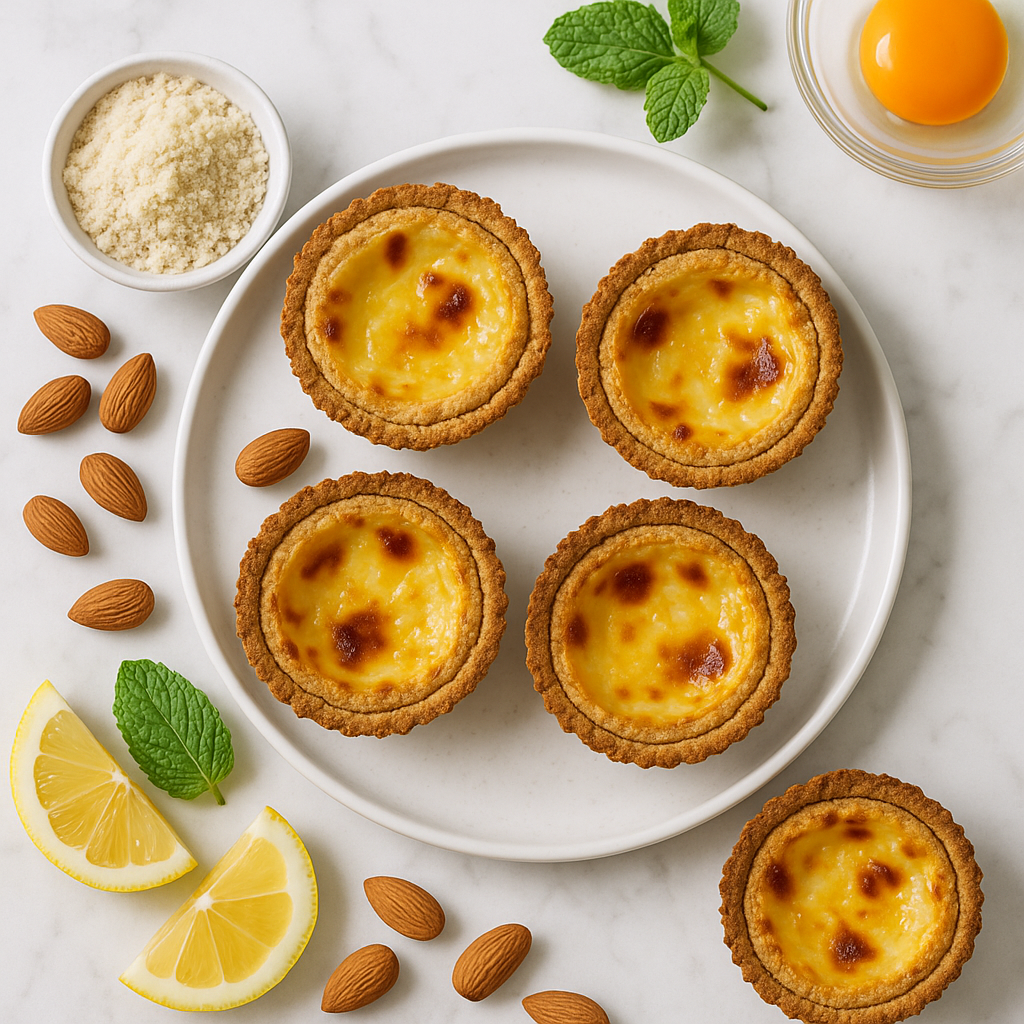
When these tarts come out of the oven, the custard surface carries pale amber patches where the heat has kissed the top, a characteristic you associate with the real thing from Lisbon. The almond flour shell is golden and firm at the edges, with a slightly tender crumb that holds its shape cleanly when you lift a tart from the tin. The smell coming out of the oven is warm and lightly sweet, with a toasty nuttiness from the almond flour that standard pastry does not produce. Biting in, the contrast matters: the crust is crisp at the base and slightly chewy at the rim, while the custard inside is set but wobbles very gently at the centre. The flavour is rich without being cloying. The erythritol and maple syrup together create a background sweetness that feels natural rather than artificial, and the vanilla and coconut milk give the custard a rounded, almost floral depth. The process involves blind-pressing the crust into a muffin tin, par-baking briefly, then pouring in the custard and finishing at high heat to achieve that characteristic scorched top.
These tarts sit well within several eating frameworks that prioritise steady energy and controlled sugar intake. At 4g of sugar per tart and a low net carbohydrate count once fibre is accounted for, they are compatible with low-sugar eating plans and work within many low-carb approaches, though they are not strictly ketogenic due to the oats. They are gluten-free as written, making them accessible for anyone avoiding gluten. The 8g of protein per tart is meaningful, particularly for people who struggle to hit protein targets at breakfast without resorting to shakes or heavily processed foods. Athletes and active people will find these a useful recovery option when they want something satisfying without excess refined carbohydrates. People managing insulin sensitivity or working with a dietitian on blood sugar control will appreciate that the sweetness here comes almost entirely from erythritol, which does not raise insulin levels. Anyone following a dairy-free diet will also note that this recipe contains no butter or cream, using coconut milk and almond milk throughout.
Meal prep is where this recipe genuinely earns its place in a weekly routine. You can press and par-bake the almond flour shells up to three days in advance and store them at room temperature in an airtight tin, ready for filling whenever you need them. Once filled and fully baked, the tarts keep well in the refrigerator for up to four days in a sealed container. They are good cold straight from the fridge, which makes them a convenient grab-and-go breakfast, but a 60-second warm in an oven at 160 degrees brings the crust back to life nicely. Do not microwave them, as the crust loses its texture quickly that way. For variations, you can add a teaspoon of cinnamon to the custard mixture for a warmer spice note that pairs well with the coconut milk base. Swapping the vanilla for a small amount of orange zest gives the custard a brighter, more citrus-forward character that works beautifully. If you want a higher protein version, replace half the almond milk with a neutral-flavoured protein shake. Scroll down to the full recipe card for exact timings, temperatures, and tin size guidance.
Ingredients
- 180 g almond flour (fine blanched almond flour works best)
- 40 g rolled oats (use certified gluten-free oats if needed)
- 2 tbsp coconut oil (melted and cooled)
- 1 tbsp maple syrup (just for binding the crust)
- 1 pinch fine sea salt
- 4 large eggs (free-range if possible)
- 2 large egg yolks (adds richness to the custard)
- 250 ml full-fat coconut milk (from a can, well stirred)
- 100 ml unsweetened almond milk
- 3 tbsp erythritol (or monk fruit sweetener, adjust to taste)
- 2 tbsp plain Greek yogurt (full fat, for extra creaminess and protein)
- 1 tsp pure vanilla extract
- 1 tsp ground cinnamon (plus extra for dusting)
- 1 tsp ground nutmeg
- 1 tsp tapioca starch (helps the custard set smoothly)
Instructions
- 1
Preheat your oven to 190 degrees Celsius, or 375 Fahrenheit. Lightly grease a 12-hole standard muffin tin with a little coconut oil or use a non-stick tin.
Silicone muffin tins make removing the tarts very easy once cooled.
- 2
Make the crust by combining the almond flour, rolled oats, sea salt, melted coconut oil, and maple syrup in a bowl. Mix until the mixture resembles damp sand and holds together when you press a small amount between your fingers.
If the mixture feels too dry, add half a teaspoon of water at a time until it just holds its shape.
- 3
Divide the crust mixture evenly among the 12 muffin holes, about one heaped tablespoon per hole. Use your fingers or the back of a small spoon to press the mixture firmly up the sides and across the base to form a shell about 3 to 4mm thick.
Press firmly into the corners where the base meets the sides to avoid cracks after baking.
- 4
Par-bake the crusts for 8 minutes until they are just turning golden at the edges. Remove from the oven and set aside while you make the custard. Leave the oven on.
- 5
In a medium saucepan over low heat, gently warm the coconut milk and almond milk together until just steaming. Do not let it boil. Remove from heat.
Warming the milk first prevents the eggs from cooking when the mixture comes together.
- 6
In a mixing bowl, whisk together the whole eggs, egg yolks, erythritol, Greek yogurt, vanilla extract, cinnamon, nutmeg, and tapioca starch until smooth and well combined.
Strain the finished custard through a fine mesh sieve for an ultra-smooth texture.
- 7
Slowly pour the warm milk mixture into the egg mixture, whisking constantly as you go. Keep whisking until everything is fully combined and there are no streaks remaining.
- 8
Strain the custard through a fine mesh sieve into a jug. This removes any bits of cooked egg and ensures a silky smooth filling. Pour the custard carefully into each par-baked crust shell, filling to about three-quarters full.
Using a jug with a spout makes pouring much neater and less messy.
- 9
Bake at 190 degrees Celsius for 15 minutes, until the custard is mostly set but still has a slight wobble in the centre. The edges should look firm and the tops pale.
- 10
Switch the oven to the grill or broiler setting and move the tray to the upper third of the oven. Grill for 2 to 3 minutes, watching very closely, until dark brown spots appear on the surface of the custard. This char is the signature of authentic pasteis de nata.
Do not walk away during this step. The custard can go from perfectly charred to burnt in under a minute.
- 11
Remove from the oven and allow the tarts to cool in the tin for 10 minutes before carefully lifting them out. Dust lightly with extra ground cinnamon and serve warm.
A small offset spatula or butter knife helps to gently loosen the tarts from the muffin tin without breaking the crust.
Nutrition per serving
145kcal
Calories
8g
Protein
9g
Carbs
10g
Fat
2g
Fibre
4g
Sugar
65mg
Sodium
Pro Tips
- ✓
Full-fat coconut milk gives a much creamier custard than the light version, so do not swap it here.
- ✓
Erythritol can crystallise slightly as it cools. If you prefer, use powdered erythritol or monk fruit blend for a smoother finish.
- ✓
These tarts taste best eaten slightly warm. Reheat them in the oven at 160 degrees for 5 minutes rather than microwaving.
- ✓
If your custard cracks during baking, your oven was likely too hot. Try reducing by 10 degrees next time.
- ✓
For a more traditional flavour, add a tiny strip of lemon zest to the warm milk while it heats, then remove before combining with the eggs.
Frequently Asked Questions
Variations
- •
Lemon Zest Custard Tarts
Add the finely grated zest of one lemon to the custard mixture along with the vanilla. The citrus brightness cuts through the richness beautifully and adds a very traditional Portuguese note.
- •
Dairy-Free Version
Replace the Greek yogurt with a dairy-free coconut yogurt at the same quantity. The rest of the recipe is already dairy free, making this swap very straightforward.
- •
Spiced Chai Custard Tarts
Add half a teaspoon of ground cardamom and a quarter teaspoon of ground ginger to the custard alongside the cinnamon and nutmeg for a warm chai-inspired flavour profile.
- •
Mini Tart Version
Use a 24-hole mini muffin tin and halve the crust pressing amount per hole. Reduce the baking time for the filled tarts to 10 minutes, then grill for 1 to 2 minutes. Great for brunches and sharing platters.
Substitutions
- •Almond flour → Sunflower seed flour (Use at a one-to-one ratio for a nut-free version. The crust will be slightly darker in colour but tastes great.)
- •Full-fat coconut milk → Full-fat oat milk or whole dairy milk (Dairy milk will add slightly more protein and change the flavour to be more traditional. The custard will be slightly less rich but still delicious.)
- •Erythritol → Monk fruit sweetener, raw honey, or maple syrup (Use at a one-to-one ratio for granulated alternatives. Honey or maple syrup will increase the sugar content but provide a more natural sweetness.)
- •Tapioca starch → Arrowroot powder or cornflour (Use at the same quantity. All three help the custard set smoothly without affecting the flavour.)
- •Greek yogurt → Coconut yogurt or skyr (Coconut yogurt makes it fully dairy free. Skyr boosts protein even further and adds a mild tang.)
- •Coconut oil in crust → Unsalted butter or ghee (Butter gives a slightly richer flavour to the crust and works at the same quantity.)
🧊 Storage
Store cooled tarts in an airtight container in the refrigerator for up to 3 days. Reheat in the oven at 160 degrees Celsius for 5 minutes before serving. Do not store at room temperature for more than 2 hours due to the egg custard filling.
📅 Make Ahead
The almond flour and oat crusts can be made, pressed into the tin, par-baked, and stored in an airtight container at room temperature for up to 24 hours before filling and baking. The custard mixture can be whisked together and kept covered in the fridge for up to 12 hours. Give it a good stir before pouring into the shells.