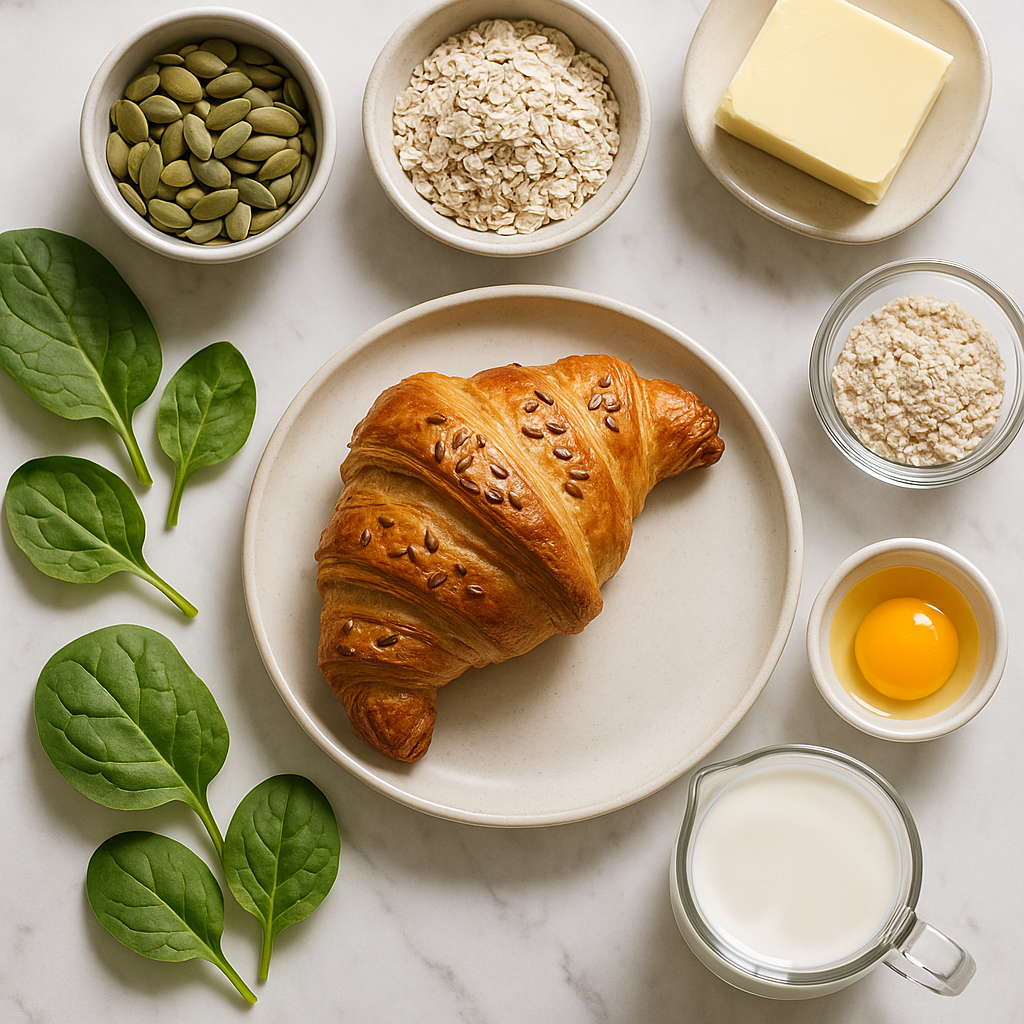
Classic French Croissant Recipe From Scratch With a Healthy Twist takes one of the most beloved pastries in the world and gives it a thoughtful nutritional overhaul without stripping away what makes a croissant worth eating in the first place. The primary benefit here is a meaningful protein boost, hitting 7 grams per croissant, which is genuinely unusual for a laminated pastry. Most traditional croissants clock in with little to no protein and considerably more fat and calories. At 210 calories and 10 grams of fat, this version sits noticeably lighter than a standard French bakery croissant, which routinely exceeds 300 calories and 17 grams of fat. The addition of whole wheat flour and a Greek yogurt butter blend are the two changes doing the heavy lifting. This is not a compromise recipe that produces a sad, dense roll. The lamination process is fully intact, the layers still shatter when you bite through them, and the interior is still soft and honeycomb-like. If you want a croissant that fits into a health-conscious morning without sacrificing the craft, this is the one to spend a weekend making.
The ingredient list is carefully constructed, and every component earns its place. The blend of 250 grams whole wheat bread flour with 250 grams white bread flour is a deliberate balance. Whole wheat flour alone would produce too dense and tough a dough for lamination, but at a 50/50 ratio it contributes 3 grams of fibre per serving, adds B vitamins including niacin and thiamine, and brings a mild nutty flavour without compromising the gluten structure needed for those distinct layers. The 7 grams of instant yeast provides consistent, reliable fermentation without requiring activation in warm liquid first. Fine sea salt at 8 grams controls yeast activity and strengthens the dough structure. Raw honey replaces refined sugar and contributes trace minerals alongside its natural sweetness. The 280 ml semi-skimmed milk adds protein and fat to enrich the dough, while the 60 ml cold water keeps the temperature controlled during mixing. The 20 grams of unsalted butter incorporated into the dough itself softens handling. The real star of the lamination block is the combination of 180 grams unsalted butter with 60 grams full-fat Greek yogurt, which introduces additional protein and a faint tang that rounds out the flavour beautifully.
The process of making these croissants is genuinely satisfying to work through, and the result is something you can see and smell before you ever take a bite. The dough comes together smooth and slightly tacky, firming up during its cold rest into something you can roll confidently. When you fold the butter-yogurt block into the dough through a series of turns and rests, you are creating distinct layers that will separate and puff during baking. The unbaked croissants, shaped into their classic crescent and left to proof, look almost modest on the tray. Then the oven works its transformation. The egg and milk wash turns each surface into a deep amber, glossy shell that crackles faintly when pressed. The smell coming from the oven is rich and buttery with a background warmth from the whole wheat. When you pull a croissant apart with your hands, the inside is open and feathery, with visible layers that pull away in ribbons. The flavour has the classic buttery richness you expect, with a gentle tang from the yogurt and a subtle earthiness from the whole wheat that standard croissants do not have.
These croissants are a strong fit for anyone working toward a higher protein breakfast without giving up the pleasure of eating something that took real effort to make. The 7 grams of protein per croissant is meaningful when you are pairing it with eggs or a protein shake, and the 3 grams of fibre support digestive health and help sustain energy levels through the morning, unlike a purely refined-flour pastry. This recipe is naturally meal prep friendly, which makes it realistic for busy weeks. The whole wheat component delivers complex carbohydrates that release energy more steadily than white flour alone. For those following a non-vegetarian or vegetarian diet, this fits comfortably. Athletes who need calorie-dense but nutritionally complete breakfasts will appreciate the macro balance. People managing their weight who still want to eat real food, rather than processed low-fat alternatives, will find this a genuinely satisfying option. The reduced fat content compared to traditional croissants means you can include them in a calorie-conscious plan without the mental gymnastics of trying to fit a 300-calorie pastry into your morning.
For meal prep, these croissants are best made in a full batch over a weekend and stored strategically. Once fully baked and cooled, they keep at room temperature in an airtight container for up to two days. For longer storage, freeze them individually on a tray first, then transfer to a freezer bag where they will keep well for up to two months. To reheat from frozen, place them in a 170 degree oven for 10 to 12 minutes until warmed through and the crust crisps back up. Avoid the microwave, which turns the layers soft and chewy rather than flaky. You can also refrigerate the shaped, unbaked croissants overnight before their final proof and bake them fresh in the morning, which gives you warm croissants without doing all the work on the same day. For variations, try adding a teaspoon of cinnamon to the dough for warmth, or brushing the finished croissants with a light honey glaze straight from the oven. A savoury version works well too by reducing the honey and adding finely grated parmesan to the butter block. Find the full method, timings and lamination instructions in the recipe card below.
Ingredients
- 250 g whole wheat bread flour (finely milled works best)
- 250 g white bread flour (plus extra for dusting)
- 7 g instant yeast (one standard sachet)
- 8 g fine sea salt
- 1 tbsp raw honey (replaces refined sugar)
- 280 ml semi-skimmed milk (warmed to 20 degrees Celsius)
- 60 ml cold water
- 20 g unsalted butter (softened, for the dough)
- 180 g unsalted butter (cold, for the butter block)
- 60 g full-fat Greek yogurt (strained overnight, very thick)
- 1 large egg (for egg wash)
- 2 tbsp semi-skimmed milk (for egg wash)
Instructions
- 1
Combine both flours, instant yeast, and sea salt in a large mixing bowl. Make a well in the centre and add the honey, warm milk, cold water, and softened butter. Mix until a shaggy dough forms, then knead on a lightly floured surface for about 8 minutes until smooth and slightly tacky. Do not over-knead as you want the gluten to stay manageable for rolling later.
The dough should feel soft but not sticky. If it clings to your hands, add flour one tablespoon at a time.
- 2
Shape the dough into a flat rectangle about 2cm thick, wrap tightly in cling film, and refrigerate overnight for at least 8 hours. This slow cold fermentation builds flavour and relaxes the gluten so rolling becomes much easier the next day.
Flattening the dough before chilling means it cools through quickly and evenly.
- 3
The next morning, prepare your butter block. Beat the cold 180g butter with the strained Greek yogurt using a rolling pin and bench scraper until they are completely combined and pliable but still cold. Shape the mixture into a 15cm square between two sheets of baking parchment and refrigerate for 20 minutes until firm but bendable.
The butter block should flex without snapping when you bend it slightly. If it cracks, it is too cold. If it squishes, it is too warm.
- 4
Remove the chilled dough from the fridge and roll it out on a lightly floured surface into a rectangle roughly 30cm by 20cm. Place the butter block in the centre and fold the dough over it like an envelope, pinching the seams firmly to seal the butter inside completely.
Work quickly to keep everything cold. If the kitchen is warm, chill the dough for 10 minutes before continuing.
- 5
Roll the dough gently away from you into a long rectangle about 60cm by 20cm, using smooth even pressure. Fold into thirds like a business letter (a letter fold), wrap in cling film, and rest flat in the freezer for 20 minutes. Repeat this roll and fold process two more times, freezing between each fold. You will complete three letter folds in total.
Mark the dough with one, two, or three finger indentations so you remember which fold you are on.
- 6
After the third fold, wrap the dough and refrigerate overnight again. This second cold rest firms the layers and makes cutting much cleaner. Do not skip this step.
- 7
The next day, remove the dough and let it sit at room temperature for 10 minutes. Roll it out into a large rectangle about 50cm by 30cm and 4mm thick. Using a sharp knife or pizza wheel, cut the rectangle into 12 long triangles with a base of about 8cm each.
A sharp blade is essential. Pressing rather than dragging prevents the layers from compressing at the edges.
- 8
Make a small 1cm nick at the base of each triangle, then roll each one from the base up toward the point with gentle, even pressure, keeping the tip tucked underneath. Curl the ends slightly toward each other to form a crescent shape. Place on two lined baking trays, spaced well apart.
The nick at the base helps the croissant curve evenly during shaping and baking.
- 9
Whisk together the egg and 2 tablespoons of milk. Brush the croissants lightly with egg wash, being careful not to let it drip down the cut layers as this can glue them together and reduce flakiness. Leave the croissants to proof at cool room temperature (around 20 degrees Celsius) for 2 to 3 hours until they look visibly puffy and jiggle gently when you shake the tray.
A warm room will melt the butter layers. Cool and patient proofing always gives better results.
- 10
Preheat your oven to 200 degrees Celsius (fan 180). Apply a second light coat of egg wash just before baking. Bake for 18 to 22 minutes until a deep golden brown all over. Rotate the trays halfway through for even colour. Transfer to a wire rack and allow to cool for at least 10 minutes before serving.
Resist cutting them open immediately. The interior structure continues to set as they cool, giving you that perfect honeycomb crumb.
Nutrition per serving
210kcal
Calories
7g
Protein
24g
Carbs
10g
Fat
3g
Fibre
3g
Sugar
210mg
Sodium
Pro Tips
- ✓
Keep every component cold throughout the lamination process. Warm butter melts into the dough instead of staying in distinct layers.
- ✓
Use a kitchen scale for all measurements. Croissant dough is unforgiving with volume measurements.
- ✓
The Greek yogurt in the butter block adds protein and a very slight tang that deepens the flavour.
- ✓
If your dough springs back aggressively during rolling, it needs more rest. Wrap it and return it to the fridge for 15 minutes.
- ✓
Whole wheat flour absorbs more liquid than white flour, so resist the urge to add extra flour if the dough feels slightly tacky.
- ✓
Baking on a preheated baking stone or steel gives an even better base crust, though a standard tray works well.
- ✓
Day-old croissants are brilliant toasted and served with almond butter and sliced banana for a high-protein breakfast.
Frequently Asked Questions
Variations
- •
Almond Protein Croissant
Before rolling each triangle, spread a thin layer of almond butter mixed with a teaspoon of honey across the dough. Roll and bake as directed, then top the baked croissant with a sprinkle of flaked almonds and a light dusting of powdered erythritol for a high-protein, nutty breakfast option.
- •
Seeded Multigrain Croissant
Add 2 tablespoons of mixed seeds (sesame, sunflower, and poppy) to the dough at the initial mixing stage and brush the egg-washed croissants with a generous scatter of sesame and linseeds before baking. This boosts fibre and omega-3 content considerably.
- •
Spelt Flour Croissant
Replace the whole wheat bread flour with light spelt flour for a slightly softer, more digestible croissant with a gentle nutty sweetness. Spelt contains a different gluten structure that many people find easier on digestion than conventional wheat.
Substitutions
- •Semi-skimmed milk → Unsweetened oat milk or almond milk (Use the same quantity. Oat milk gives the closest texture and flavour to dairy. The croissants will not be dairy-free because of the butter, but this reduces overall dairy if needed.)
- •Raw honey → Pure maple syrup (Use the same quantity. Maple syrup has a slightly lower glycaemic index than refined sugar and adds a subtle warmth to the flavour.)
- •Full-fat Greek yogurt → Coconut cream (strained) (This makes the butter block dairy-adjacent but changes the flavour profile. The protein boost will be reduced, though the lamination technique works similarly.)
- •White bread flour → Light spelt flour (Works well and keeps the croissant lighter than using 100 percent whole wheat. Spelt is not gluten-free but is often better tolerated.)
- •Instant yeast → Fresh yeast (Use 20g of fresh yeast in place of 7g instant yeast. Crumble it directly into the warm milk and let it sit for 5 minutes before adding to the flour.)
🧊 Storage
Store baked croissants in an airtight container at room temperature for up to 2 days. To refresh them, place in a 180 degree Celsius oven for 5 to 6 minutes until crisp and warm. They can also be refrigerated for up to 4 days but will need refreshing in the oven before serving. Freeze baked croissants for up to 1 month; reheat from frozen at 180 degrees Celsius for 10 to 12 minutes.
📅 Make Ahead
The dough can be made through the shaping stage and frozen for up to 4 weeks. Simply place shaped unbaked croissants on a lined tray, freeze solid, then bag them up. Thaw overnight in the fridge, proof at cool room temperature for 1 to 2 hours, egg wash, and bake as directed. This is a brilliant way to enjoy fresh croissants any morning without the multi-day process.